Sunday, March 7, 2010

Radicant part 3

Marcel Duchamp, Fountain, 1917


The readymade offers the possibility for common objects to attain artistic stature. It's a gesture of choice rather than production. The second point is indifference, the work is lacking visually. "This idea of indifference is closer to certain concepts of Eastern philosophy: the Taoist principle of non-action (Wu wei), or, still more, that joyous form of indifference to the world, linked to the feeling of impermanence, that is the basis of Buddhism." The third idea is displacement. The readymade is most potent in the context of the museum which confirms its authority as art.
Marcel Duchamp, L.H.O.O.Q.
Philippe Parreno and Pierre Huyghe

"All human production that does not conform to a logic of profit maximization thereby acquires the de facto status of an antiquated worker's practice known in France as perruque, a practice that consists of using factory tools and machines outside of normal work hours in order to produce objects for personal use or for an undeclared job."

"It was a lie, of course; every society is born of aleatory circumstances, but after the fact a narrative is devised that finds a foundation for this chaos in natural order."
Kim Soo-Ja
Pascale Marthine Tayou

Global economy is capable of functioning in real time on a planetary scale.
Thomas Hirschhorn
Subodh Gupta

"To practice citation is to appeal to an authority: in measuring him- or herself against the master, the artist claims a place in a historical lineage and thereby legitimates first of all his or her own position, but also, tacitly, a vision of culture in which signs unequivocally 'belong' to an author (artist x or y), to whom the present work refers, ironically, aggressively, or admiringly."
Sam Durant

"'the Age of Access' amounts to a progressive devaluation of property. When a buyer acquires a an item, he explains, his or her relationship with the seller is short-lived. With a rental, by contrast, the relationship with the provider is ongoing." "In aesthetic terms, what is dying is the mode of acquisition, replaced by a generalized practice of access to experience, whose object has become merely a means. This is a logical evolution of the capitalist system: power, in the past based on landed property (space), has slowly shifted toward pure capital (time, during which money 'works').

hjkl

Frank Gerritz
Frank Gerritz
Juan Usle
Juan Usle
Juan Usle
Juan Usle
Eva Rothschild
Eva Rothschild
Eva Rothschild
Eva Rothschild
Walead Beshty
Yves Klein
Hiroyuki Doi
Serban Savu
Serban Savu
Tauba Auerbach
Tauba Auerbach
Scott Short
Scott Short
Scott Short
Scott Short
Los Carpinteros
Los Carpinteros
Hiroyuki Doi
Hiroyuki Doi
Hiroyuki Doi

Monday, March 1, 2010

Radicant part 2

Radicant aesthetics considers the conflation between space and time. Data saturation and connectivity along with hyper consumption via disposable production and obsolescence, all contribute to a sense of accessibility. Divisions marked by geography, production time and investment no longer define or impede the conception of form. Instead the Radicant attempts to "spatialize time" through the geometry of translation, "topology". This is a measure of quality rather than quantity. "Thus, it refers to movement, to the dynamism of forms, and characterizes reality as a conglomeration of transitory surfaces and forms that are potentially movable. In this sense, it goes hand in hand with translation as well as with precariousness."

-The dismantling of time and space can be seen in education. MIT now offers lecture notes and recordings for free online. An experience privileged by money and proximity is now mostly a question of time and ambition. Information is readily available, permitting almost anyone the ability to learn almost anything. The democratizing process has further flattened the surface, with many people assimilating the same information and experience through mass media and the inter web.

"In an immediate environment that is constantly being updated and reformatted, in which the short-lived is overtaking the long-term and access is overtaking ownership, the stability of things, signs and conditions is becoming the exception rather than the rule."
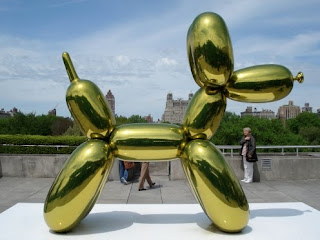
Jeff Koons
Jenny Holzer
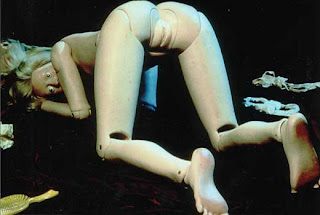
Cindy Sherman
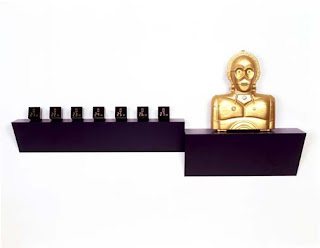
Haim Steinbach
Cady Noland

"But in a radicant universe, principles mingle and multiply by means of combinations." In a postmodern world everything is equal. By contrast the radicant world seems to be marked by exponential growth. If the Oil well symbolized the explosive nature of the first half of the twentieth century, perhaps the particle accelerator best describes the altermodern/radicant period.
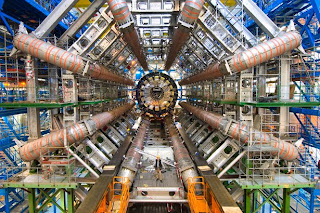
Particle Accelerator, CERN, Switzerland
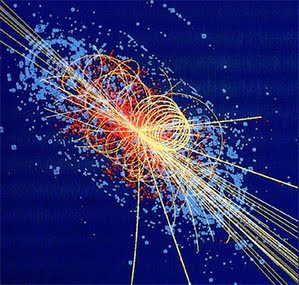
Particle Accelerator pictogram

"It may be that, in these early years of the twenty first century, our own modernity is developing on the basis of this collapse of the long term, at the very heart of the consumerist whirlwind and cultural precariousness, countering the weakening of human territories under the impact of the globalized economic machine." p.86 Does this reaffirm postproduction? Is this another attack on tradition?
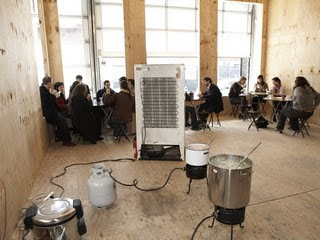
Rirkrit Tiravanija

Much of this argument seems to be hinged on an aesthetic of the precarious or instability. This is about ephemeral experience instead of traditionally measured objects prepared for the gallery.

Maurizio Cattelan

This is period of history defined by the city population. Cultural density encourages the flaneur as artistic model. An observer, wander and assessor, the flaneur engages the community and adjudicates value.
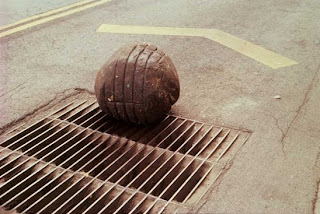
Gabriel Orozco, Yielding Stone, 1993

'Each megacity is a concentration of the world economy.'
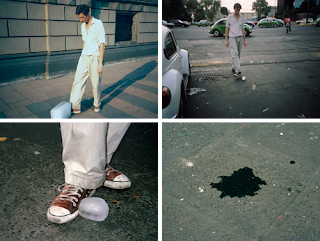
Francis Alys

Walking and flanerie as a sign of criminality? Wandering as a political inquiry into the city.

The twentieth century is defined by a Hegelian sense of progression. "The notion of the painting as a window, which dominated the classical age and which organizes the visible around the perceptual channel of monocular perspective, is to space what the Hegelian vision of history is to time: a tension modulated toward a single point. At the end of the nineteenth century, pictorial modernity begins to obstruct perspective, diverting the linearity of space toward time." p. 101

Fragmentation suggests it is no longer possible to have a master narrative.

"quilting point" suggests an artwork is no longer the terminal destination, but just a point along the continuum. recycling postproduction thesis.
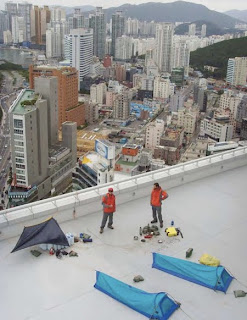
Abraham Poincheval and Laurent Tixador

Expedition as inquiry into displacement as a consequence of culture. "The emergence of the journey as a compositional principle has its source in a cluster of phenomena that form part of a sociology of our visual environment: globalization, the transformation of tourism into everyday phenomenon, and the advent of the computer screen as a feature of daily life, a phenomenon that began in the 1980s but has accelerated since the early 1990s with the explosion of the internet." p.114

"...the contemporary journey-form combines the forms of the ruin (culture after the modernist narrative) and that of the flea market (the eBay economy) in nonhierarchical and nonspecific spaces (globalized capitalism)." p.117

Julie Mehretu

This painting captures the chaotic sense of layer and interconnectedness found in the contemporary world. A topography, a translation of interaction. Reminds me of Pollock. A network of relationships.

Doug Aitken: "How can I break through this idea [that time is linear], which is reinforced constantly? How can I make time somehow collapse or expand, so it no longer unfolds in this one narrow form?" p.122
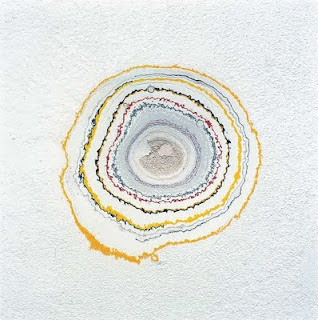
Pierre Huyghe

Here Pierre considers time as an accumulation on a gallery wall that has been successively sanded to reveal previous layers of paint.

Globalization seeks to unify the world into a single esperanto, or set of agreed symbols. Translation by contrast offers to reinterpret what is given, bringing new life and valuing individual interpretation.

"No doubt, one could describe the ambition of the twenty-first-century artist as the desire to become a network."

Instead of producing an object, the artist works to develop a ribbon of significance, to propogate wavelength, the modulate the conceptual frequency on which his propositions will be deciphered by an audience." p.134

Monday, February 22, 2010

Radicant part 1

With the globalization comes standardization. Bourriaud suggests this includes identity. We have a portable culture, one less dependent on geographic proximity or neighborhood identity and more focused as expression takes form through "images, clothing, cuisine, and rituals." How will this affect real estate markets? If younger generations do not feel compelled to settle or identify with a particular place, will real estate values become unstable? As a culture, if we are not tied to our land but instead to our iPhone, we will all be chameleons, connected to data and ready to adopt the most recent trend. Life becomes a trade instead of an investment. Connectivity favors short term decisions.

According to feminist and sexuality theories devised by Michel Foucault and Jacques Lacan we have entered a "postidentitarian regime" defined only by actions performed.

Tsuyoshi Ozawa

"It is a matter of replacing the question of origin with that of destination. Where should we go?"

Bourriaud then cites Walter Benjamin and Art in the Age of Mechanical Reproduction, this is an inauthentic world of infinite reproduction. He suggests this notion will be especially challenging for Westerners who are the cultural heirs.

"Altermodernity promises to be a translation-oriented modernity, unlike the modern story of the twentieth century, whose progressivism spoke the abstract language of the colonial West." Explain? He suggests a type of Esperanto universal subtitling that affords no authenticity. Instead artists will be valued for the intercultural connections they establish. How will the artist profit if authenticity is questioned at every turn?

Globalization displaces cultural tradition for labor. Capital liquidity controls culture, further evidence of a homogeneous world. We all come to be part of the same tradition, responding to the same symbols and watching the same entertainment. With diverse values of increasingly hard to find, what will happen to creativity? The assimilation age will pillage others and history via globalization and democratization, leaving fewer and fewer stones unturned.

Is art only responsible for producing style? Is this the only function?
Piet Mondrian
Joseph Beauys

How is progress defined? The postmodern globalized world only measures progress in terms of monetary gain, but when GDP falters what happens to our sense motion?

"And yet the immigrant, the exile, the tourist, and the urban wanderer are the dominant figures of contemporary culture." 21st century flaneur?
Sarah Morris

"Thus, today's artists do not so much express the tradition from which they come as the path they take between that tradition and the various contexts they traverse, and they do this by performing acts of translation." Translation as interpretation? Selection as opposed to subtraction. Dj culture, choice is cheap and available.
Mike Kelley, Memory Ware Flat #29, 2001

"Thus, radicant art implies the end of the medium-specific, the abandonment of any tendency to exclude certain fields from the realm of art." What about craft? A tradition that inherently looks back and has difficulty assimilating the present. Does an artist work in service of his talents or the idea?

"Airports, cars, and railroad stations become the new metaphors for the house, just as walking and airplane travel become the new modes of drawing."
Franz Ackermann
Julie Mehretu

"Abstraction is the very language of inevitability."

"A century later, one cannot but admire the contemporary relevance of his thought, which declares that the source and driving energy of all beauty is difference, yet never lapses into idealization of the other."

Something is always lost in translation.

Pg. 69 - Exoticism is on the decline, suggests a loss of creativity , energy, life - equated to entropy. Multitude represents the life force of human experience. We have a creolized world and art market.

Rareity as opposed to seriality.
Haim Steinbach
Kelley Walker

"Creolization produces objects that express a journey rather than a territory, objects that are province of both the familiar and the foreign." p. 74

"Epicurus wrote that the universe was nothing but a rain of atoms before the clinamen (spontaneous deviation) caused a pile-up accident, a collision that was the origin of worlds. Before the encounter takes place, the atoms fall like drops of rain, without meeting; their existence, as elements taking part in the encounter, thus proves to be purely abstract." p.75

Graft - tissue of one is merged to another.